
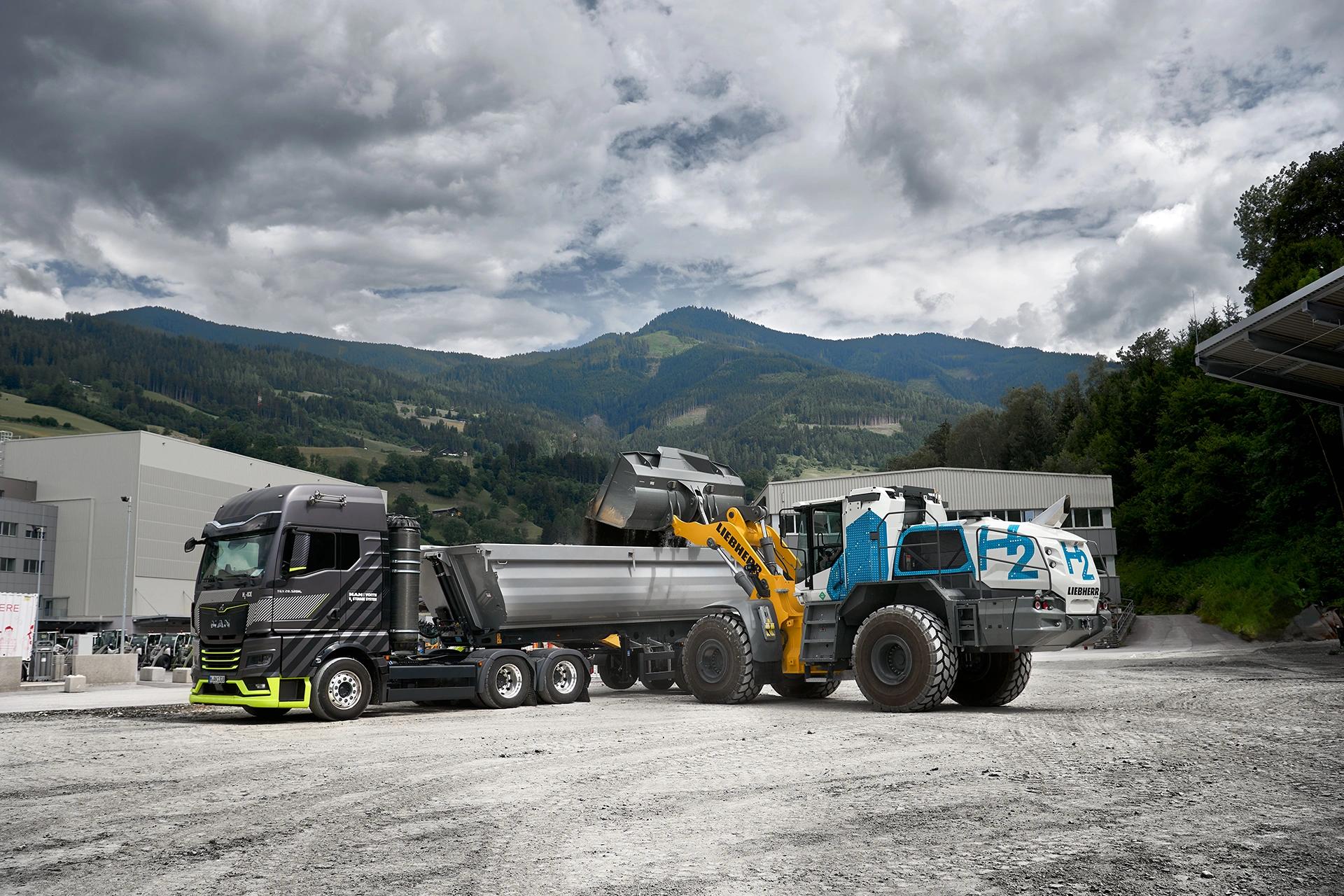
Liebherr’s hydrogen-powered L 566 H is undergoing real-world trials at a German port, promising diesel-like performance and fast refueling. But can the technology compete on cost?
A hydrogen-powered wheel loader is being put to work at the port of Bremerhaven, Germany, where Liebherr’s L 566 H prototype is handling sand, gravel and rock alongside conventional equipment. The multi-year trial will test whether hydrogen can provide a practical alternative to diesel in demanding material-handling operations.
The machine is working for Georg Grube GmbH, feeding conveyors, moving bulk materials and loading trucks. According to Liebherr’s November 6 announcement, the project will evaluate whether hydrogen technology can deliver the reliability and productivity required in a busy industrial environment.
A Familiar Machine With a Different Fuel
The L 566 H is based on Liebherr’s conventional L 566 XPower wheel loader but replaces its diesel engine with a hydrogen combustion engine. Unlike hydrogen fuel cells, which generate electricity to power electric motors, this system burns hydrogen directly in an internal combustion engine.
Liebherr first introduced the prototype in 2024 and previously tested it at an Austrian quarry. The Bremerhaven deployment takes that development into a working port, where consistent productivity and minimal downtime are essential.
The manufacturer has previously reported refueling times of approximately 10 to 15 minutes, potentially allowing hydrogen equipment to maintain operating schedules similar to diesel machines. However, the new trial must establish whether that capability translates into dependable everyday performance.
Hydrogen vs. Diesel vs. Battery Power
Diesel remains the industry standard for good reason. Fuel is widely available, equipment is proven, and contractors understand the maintenance requirements and operating costs.
Battery-electric loaders offer zero exhaust emissions at the machine and can reduce maintenance and energy expenses. However, charging time, battery capacity and electrical infrastructure can present challenges for machines working long shifts.
Hydrogen combustion offers another approach, combining relatively quick refueling with familiar engine technology. Burning hydrogen produces no carbon dioxide from the fuel itself, although nitrogen oxide emissions remain possible. Its overall environmental benefit also depends on how the hydrogen is produced.
For larger machines operating continuously, hydrogen could offer advantages where battery charging is impractical. But those benefits must be weighed against the expense of producing, transporting and storing the fuel.
The Biggest Challenge Is Economics
Bremerhaven has something most construction sites lack: access to a regional hydrogen supply network.
The trial uses hydrogen produced with wind-generated electricity through electrolysis. The fuel is transported to a dedicated refueling station at the Fraunhofer IWES Hydrogen Lab, allowing the loader to operate within an established supply system.
That infrastructure is central to the project’s success, but it also highlights the difficulty of bringing hydrogen equipment into widespread use. Contractors working across multiple jobsites cannot rely on specialized fueling stations being available wherever their machines operate.
Cost is another unanswered question. Hydrogen production, compression, transportation and storage all require energy and investment. Battery-electric equipment avoids many of those conversion steps, while diesel benefits from a mature distribution network.
Liebherr has not released a comprehensive operating-cost comparison for the Bremerhaven trial. For contractors, the meaningful measurement will be cost per productive hour, including equipment purchase price, fuel, maintenance, infrastructure and downtime.
Where Hydrogen Could Make Sense
Ports, quarries and large industrial facilities may offer the best opportunities for hydrogen-powered equipment. Machines working predictable shifts at fixed locations could share fueling infrastructure, potentially spreading those costs across an entire fleet.
Smaller equipment and machines operating near reliable electrical connections may be better suited to batteries. Diesel, meanwhile, retains significant advantages for contractors who need equipment to operate across changing locations without specialized support.
The Bremerhaven trial will help determine whether hydrogen combustion can deliver the performance and reliability of conventional machines. Proving the economics will be the greater challenge.
For now, Liebherr’s L 566 H remains a prototype rather than a production-ready replacement for diesel. Its future may depend less on whether hydrogen can power a wheel loader and more on whether contractors can afford to keep one running.
Leave a Reply