
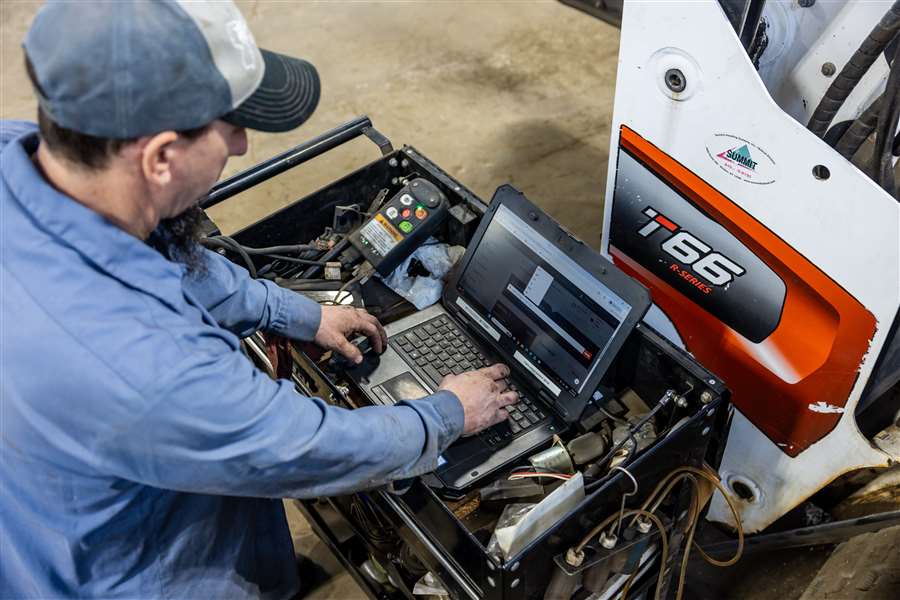
Bobcat’s new AI-powered Service Assistant is helping dealership technicians diagnose equipment problems faster, offering an early look at how artificial intelligence could change heavy equipment maintenance.
Artificial intelligence is making its way into the service departments of heavy equipment dealerships. Bobcat announced November 10 that approximately 600 technicians across its North American dealer network are now using its AI-powered Service Assistant daily to troubleshoot machines and access repair information.
Originally introduced as the Service.AI prototype at CES 2026, the system combines technical manuals, diagnostic procedures and historical service cases into a conversational interface. Rather than searching through multiple documents, technicians can describe a problem and receive relevant troubleshooting guidance.
According to Bobcat’s announcement, technicians averaged nearly 1,000 conversations per day with the assistant during its first 60 days.
From Service Manuals to AI Assistance
Modern construction equipment contains increasingly complex electronics, sensors and hydraulic systems. Diagnosing a fault can require technicians to consult multiple resources, particularly when symptoms point to several possible causes.
Bobcat’s Service Assistant is designed to simplify that process by searching the company’s existing technical knowledge and presenting relevant information through a question-and-answer interface.
At White Star Machinery in Wichita, Kansas, shop foreman Trevor Simons described a situation in which a field technician had already investigated several possible causes of a machine problem. The AI assistant suggested another item to examine, helping identify the issue.
Simons estimated that locating the same information through conventional resources might have taken an additional 30 to 60 minutes. While that’s one dealer’s experience rather than a measured average, it illustrates where the technology could prove valuable.
Early Results Show Promise
Bobcat reports that use of traditional troubleshooting guides within its My Machine platform has declined approximately 40% compared with the pre-launch monthly average. The company also says troubleshooting cases escalated for additional support have fallen more than 25% compared with the previous year.
Those figures suggest technicians are increasingly finding information without relying on conventional searches or additional assistance. However, they do not establish an equivalent reduction in repair times or equipment downtime, and Bobcat has not published independently verified productivity results.
The distinction matters because finding information faster is only one part of repairing a machine. Technicians must still confirm the diagnosis, obtain replacement parts and complete the physical work.
What It Means for Equipment Owners
For contractors, the potential benefit is straightforward: less time waiting for a diagnosis and more time with equipment on the job.
An excavator or compact track loader sitting idle can delay an entire crew. If AI helps a dealership identify a problem sooner, even modest time savings could become meaningful, particularly during busy construction seasons.
The technology may also help dealerships facing shortages of experienced service technicians. Newer mechanics could locate relevant procedures more efficiently, while experienced technicians spend less time searching documentation or responding to routine troubleshooting questions.
Bobcat emphasizes that the assistant supports trained technicians rather than replacing them. Established repair procedures and safety requirements remain in place, and technicians are responsible for verifying the information before acting on it.
Could AI Change the Equipment Repair Industry?
Bobcat’s deployment points toward a broader opportunity for construction equipment manufacturers. As machines become more sophisticated, the ability to organize and retrieve technical information may become an important part of dealer support.
Similar systems could eventually help technicians across multiple equipment brands, particularly if manufacturers expand access to service information. Independent repair shops could also benefit, although access to proprietary diagnostic data and repair documentation remains a significant consideration.
For now, Bobcat’s Service Assistant is a dealer-focused tool, and the company has not announced a comparable public version for equipment owners or independent mechanics.
The larger question is whether faster access to technical knowledge will translate into measurable improvements in repair turnaround times, labor efficiency and customer satisfaction.
Bobcat’s early results are encouraging, but those outcomes still need to be demonstrated. What is already clear is that AI is beginning to move from experimental equipment technology into everyday dealership operations, where its value will ultimately be measured by how quickly machines get back to work.
Leave a Reply