
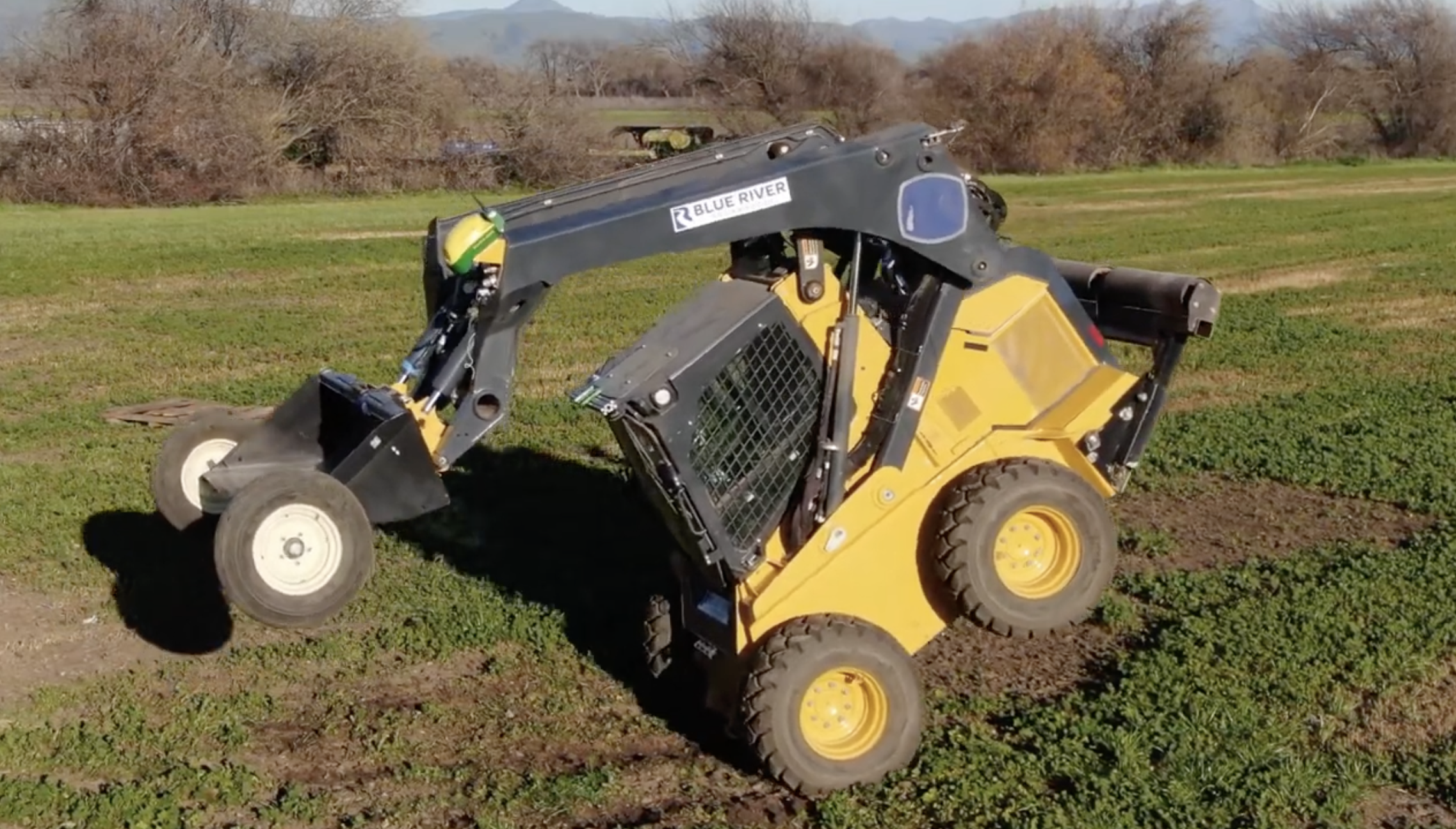
A five-ton John Deere skid steer has learned a few tricks that most operators would never attempt. Researchers have developed an artificial intelligence system capable of lifting the machine onto its two front wheels, maintaining its balance, driving across uneven terrain and spinning in place, all without anyone behind the controls.
The demonstration, detailed in a November 11 study published in Science Robotics, represents an unusual advancement in autonomous heavy equipment. Rather than programming every movement individually, researchers trained an AI system to learn how the machine responds to different control inputs and maintain its balance through complex maneuvers.
The project was led by researchers associated with ETH Zurich’s Robotic Systems Lab, working with collaborators including Intel researchers. Their test machine was a John Deere 332G skid steer loader weighing approximately five metric tons.
How AI Learned to Balance a Skid Steer
Construction equipment presents a difficult challenge for autonomous control. Hydraulic systems respond differently depending on loads, fluid behavior and operating conditions, while the weight and momentum of large machines make unexpected movements potentially dangerous.
Instead of learning through thousands of risky experiments with the actual skid steer, the researchers developed a computer simulation of its behavior. They collected approximately 90 minutes of operating data from the real machine to help model its movements, then used reinforcement learning to train the AI through repeated virtual trials.
The system learned separate behaviors for lifting onto two wheels, balancing, moving and returning safely to the ground. Those capabilities were then combined and transferred to the physical machine.
The result was a skid steer capable of raising its rear wheels, balancing on its front wheels and performing controlled movements that previously required exceptional operator skill.
More Than a Construction Equipment Stunt
The machine demonstrated more than stationary balancing. It could drive forward and backward, turn, spin and move its bucket while maintaining its position on two wheels.
Researchers also tested the system on uneven ground, including a mound approximately 30 inches high. Although the AI had been trained primarily on flat terrain, it was able to maintain balance while negotiating the obstacle.
The system accomplished these maneuvers using onboard motion sensors rather than cameras or lidar to map the surrounding terrain. Its control software also ran on a conventional laptop without requiring a powerful graphics processor.
These results suggest that advanced autonomous control may not always require extensive computing hardware or highly detailed environmental maps. However, the demonstration was conducted under research conditions and does not establish that the system is ready for unrestricted construction-site operation.
What Could This Mean for Heavy Equipment?
Balancing a skid steer on two wheels has little practical value on a typical jobsite, but the underlying technology could be much more significant.
Autonomous equipment must respond to changing ground conditions, shifting loads and unpredictable machine movements. Learning to control a loader at the limits of its balance provides researchers with a way to develop more sophisticated machine-control systems.
Similar approaches could eventually help equipment maintain stability on uneven terrain, improve automated material handling or respond more effectively to unexpected changes in machine position.
The technology could also contribute to more capable autonomous earthmoving equipment. Today’s automated machines generally operate within defined tasks and conditions, while construction sites frequently require adjustments that experienced human operators make instinctively.
Teaching machines to handle those changing conditions is one of the challenges researchers are trying to solve.
A Step Toward More Capable Autonomous Machines
The demonstration does not mean John Deere is introducing a self-balancing skid steer, nor does it suggest contractors will soon be using two-wheel maneuvers on active jobsites.
The research remains experimental, and commercial deployment would require additional work on safety, obstacle detection, reliability and integration with practical construction tasks.
Nevertheless, the results demonstrate how artificial intelligence can learn to control the complicated dynamics of heavy machinery using simulation rather than relying entirely on real-world testing.
For the construction industry, the long-term significance may have little to do with balancing on two wheels. The bigger opportunity is developing equipment that can respond to difficult operating conditions with greater precision and independence, bringing more complex construction tasks within reach of automation.
Leave a Reply