
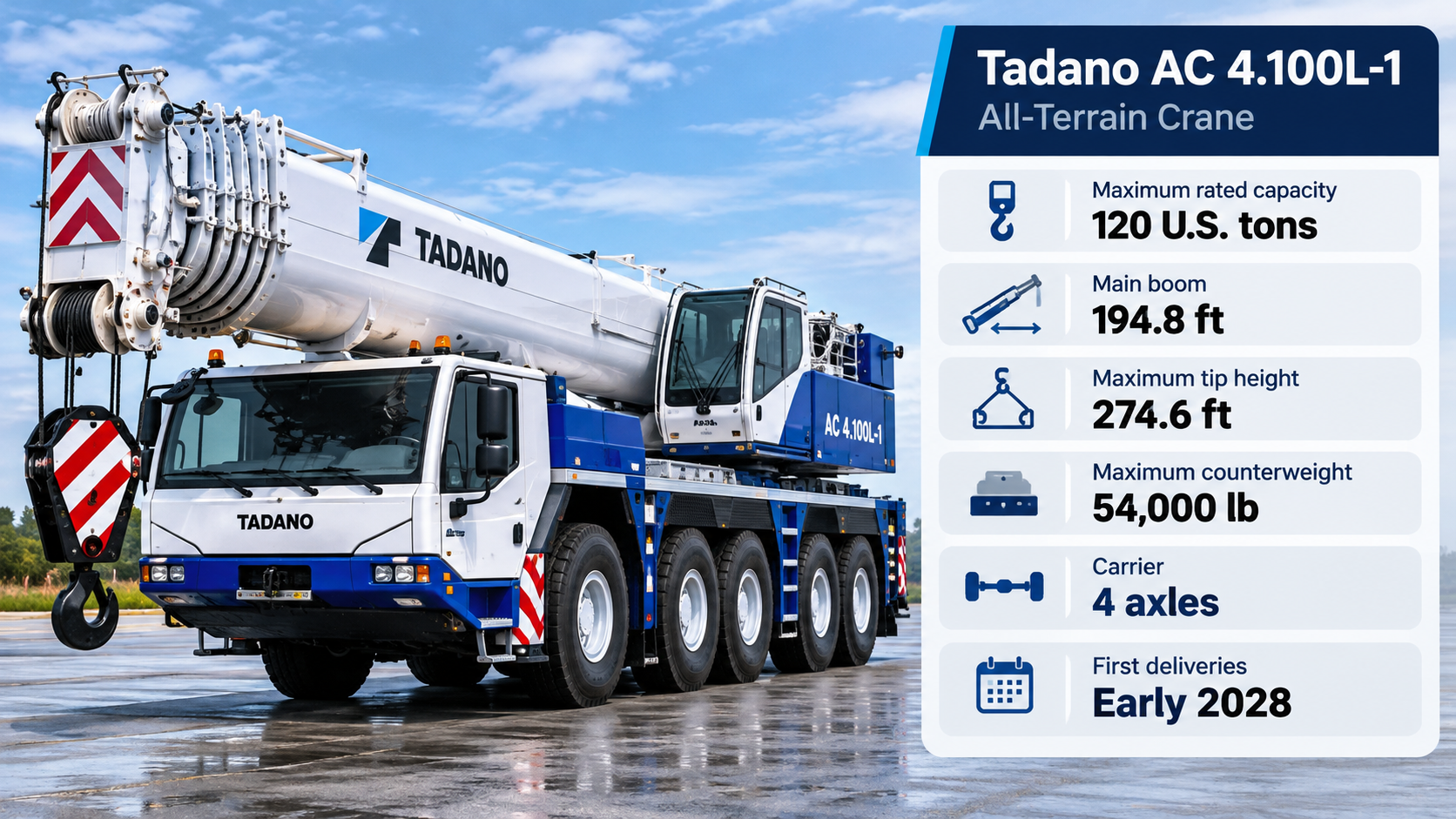
Tadano is bringing its AC 4.100L-1 all-terrain crane back into production, with first deliveries scheduled for early 2028. Announced November 17, the decision returns a long-established four-axle model to the manufacturer’s lineup rather than introducing an entirely new design. Tadano says the crane’s lifting performance, versatility and popularity among customers contributed to its return.
The AC 4.100L-1 is rated at 100 metric tonnes, with a separately published U.S. rating of 120 tons. Its six-section telescopic boom extends to 194.8 feet, while optional extensions provide a maximum tip height of approximately 274.6 feet. The crane combines those capabilities with a compact carrier designed for jobsites where maneuverability and available space are important.
Why Bring Back an Older Crane?
The AC 4.100L-1 has an established history in Tadano’s all-terrain range. According to Vertikal’s November 18 report, the model was introduced in 2001 and developed a following among crane operators, including customers who purchased multiple units. The publication also notes that machines were still being delivered relatively recently, making the interruption in production less straightforward than a conventional model discontinuation.
Tadano has not explained precisely why production stopped or identified major changes planned for the returning version. Dean Barley, president and CEO of Tadano America, Tadano Mantis and Manitex, and COO of Tadano Europe, described the model as a valued part of the company’s portfolio in Tadano’s November 17 announcement.
The crane’s specifications help explain its appeal. With a carrier approximately 8.4 feet wide, all-wheel steering and a long telescopic boom, it is suited to work in restricted urban and industrial environments. Tadano also emphasizes its axle-load configurations, which can make the crane practical for frequent travel between lifting assignments.
For contractors and rental fleets, familiarity can be valuable. Existing operators and technicians may already understand the machine’s controls and maintenance requirements, potentially reducing training and service complexity. Whether the returning version preserves those advantages will depend on its final configuration and compatibility with earlier machines.
Manufacturing Investment Supports the Return
Tadano’s announcement follows more than €100 million in investment over the past two years at its German manufacturing facilities in Zweibrücken and Lauf. The company says the spending is intended to strengthen production quality, customer support and the competitiveness of its crane lineup.
The investment provides context for the AC 4.100L-1’s return, although Tadano has not said that the factory upgrades were specifically responsible for restarting production. Independent industry reporting also leaves open the question of whether the new production run will incorporate updated components or other improvements.
For crane owners, the longer-term implications extend beyond the machine itself. Parts availability, service support and equipment reliability are particularly important for cranes that may remain in operation for decades. Tadano has emphasized continued investment in those areas, but the practical benefits for the revived model will become clearer as production and deliveries approach.
What Crane Buyers Should Consider
The returning AC 4.100L-1 offers another option for contractors seeking a relatively compact all-terrain crane with substantial reach. Its published specifications include a maximum counterweight of 54,000 pounds, a 177.1-foot maximum working radius and multiple boom-extension configurations. Those figures describe the machine’s overall capabilities, but actual lifting capacity depends on working radius, boom configuration, counterweight and outrigger setup.
Buyers comparing the Tadano with newer alternatives should evaluate lifting charts for their typical jobs rather than relying on maximum capacity alone. Transportation requirements, setup time, maintenance costs, operator familiarity and local dealer support can have a greater influence on profitability than headline specifications.
Pricing, final production specifications and potential upgrades have not yet been disclosed. With deliveries planned for early 2028, Tadano’s announcement signals continued confidence in an established crane design, but its competitiveness will ultimately depend on how the returning model performs against current alternatives in both lifting capability and ownership costs.ref=”turn553801search11″/>
For customers, the most relevant question is whether those investments translate into dependable equipment availability, parts supply and service support. Cranes are long-lived assets, and maintenance costs, downtime and manufacturer support can be just as important as lifting capacity when evaluating a purchase.
What It Means for Crane Buyers
The AC 4.100L-1’s return gives contractors and rental fleets another option in the four-axle all-terrain category. Its combination of compact dimensions and a long telescopic boom may be attractive to operators working on projects where larger cranes are difficult to position or transport.
However, an established design is not automatically a better investment than a newer machine. Buyers will need to compare lifting charts at actual working radii, axle-load restrictions, counterweight transportation, setup requirements, fuel consumption and service costs. Tadano has not released pricing or confirmed whether the revived model will receive updated components or controls.
With deliveries still more than a year away, the announcement is primarily an indication of Tadano’s product strategy rather than an immediate change in equipment availability. The decision suggests the manufacturer sees continuing value in a crane with a proven operating history, but its commercial success will depend on how the returning model compares with today’s alternatives in performance, support and total ownership costs.
Leave a Reply