
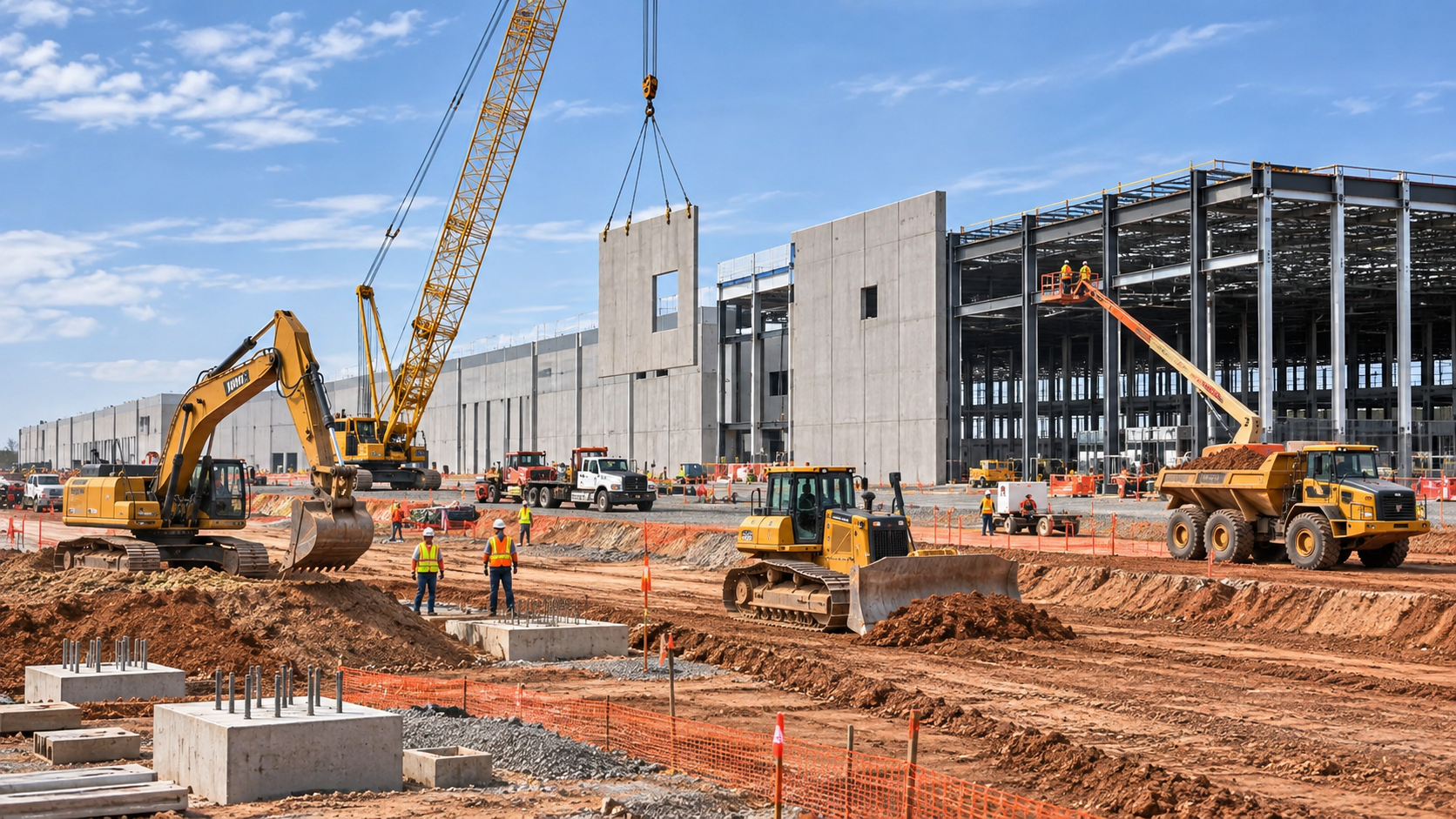
Construction spending on data centers has surged 90% in a year, even as overall U.S. construction activity declines. The AI infrastructure boom is creating new opportunities for contractors, but it is also exposing a widening divide across the industry.
America’s construction industry is experiencing two very different economic realities. While many contractors are dealing with slowing projects, rising costs and uncertain demand, companies building data centers and electrical infrastructure are enjoying an extraordinary surge in investment.
New figures released November 2 show that U.S. construction spending fell 2.7% in September compared with the same month in 2025. Yet spending on data center construction jumped 90% over that period, driven largely by the massive infrastructure investment supporting artificial intelligence and cloud computing.
According to the Associated General Contractors of America (AGC), data centers and electric power projects are now responsible for virtually all the growth in private nonresidential construction. Without those two sectors, the picture looks considerably weaker.
For contractors and heavy equipment owners, the numbers raise an important question: Is the data center boom creating a broader construction recovery, or simply concentrating work in a relatively small number of markets?
A $2.19 Trillion Industry Moving in Different Directions
Total U.S. construction spending reached a seasonally adjusted annual rate of $2.19 trillion in September 2026. That represents a 1.9% decline from August and a 2.7% decline from September 2025.
Private nonresidential construction performed somewhat better, increasing 2.3% year over year. But those gains were heavily concentrated in two categories.
Data center construction spending increased 8.6% in September alone and 90% over the previous 12 months. Private electric power construction, which includes infrastructure needed to support growing electricity demand, rose 14% year over year.
Meanwhile, all other private nonresidential construction categories combined declined 7.8% from September 2025.
The disparity is especially striking because these figures measure construction spending in current dollars, rather than inflation-adjusted activity. With construction input costs rising sharply, the amount of actual construction work being performed may be under even greater pressure than the spending figures suggest.
The AI Boom Is Becoming a Construction Boom
The rapid expansion of artificial intelligence has created enormous demand for the physical infrastructure needed to operate data centers.
These facilities require far more than buildings filled with computer servers. Large projects involve extensive site preparation, grading, drainage, foundations, access roads, utility installations and electrical infrastructure. Many also require new substations, transmission connections and supporting power facilities.
That work creates opportunities for earthmoving and heavy civil contractors, particularly those operating excavators, bulldozers, wheel loaders, articulated dump trucks and other equipment used in large-scale site development.
According to a November analysis from KPMG, annualized data center construction spending reached approximately $96.5 billion in September. Data centers accounted for more than 90% of the monthly increase in private nonresidential construction spending.
The boom is also spreading into the power sector. Electricity demand from data centers is one of several factors encouraging utilities to expand generation and transmission capacity, creating additional construction work beyond the data center properties themselves.
Not Every Contractor Is Benefiting
Despite the remarkable growth in data center investment, the rest of the construction industry is facing considerably more difficult conditions.
Private residential construction spending declined 8.9% year over year in September. Manufacturing construction also weakened, while office construction outside the data center segment continued to struggle.
Even public construction showed limited growth, rising just 1% over the previous year.
The concentration of investment matters because data center projects often involve specialized requirements, large contracts and substantial financial commitments. Major national contractors may be better positioned to secure these projects than smaller regional firms.
Associated Builders and Contractors chief economist Anirban Basu made a similar observation in the organization’s November 2 construction spending analysis. He noted that current market conditions increasingly favor larger contractors with the resources and experience to participate in major data center and power infrastructure projects.
Smaller excavation and sitework companies may still benefit through subcontracting opportunities, but that depends heavily on where projects are being built and how work is distributed.
Rising Costs Are Adding Pressure
The construction industry’s uneven recovery comes at a time when contractors are dealing with substantial increases in operating and material costs.
KPMG reported that construction input prices were 11.7% higher in September than a year earlier, with significant increases in diesel fuel, steel, copper and transportation costs.
Those increases affect nearly every type of construction project, but their impact can be especially severe for equipment-intensive operations. Earthmoving contractors depend on diesel-powered machinery, trucking capacity, replacement parts and a steady supply of materials to maintain profitability.
At the same time, large data center and power projects are competing for many of the same resources used by other contractors.
Steel, electrical equipment and skilled trades are all experiencing additional demand. Long lead times for transformers, switchgear and generators can delay projects, while labor shortages create further scheduling and cost challenges.
For contractors outside the booming data center sector, that can mean facing higher costs without enjoying the same increase in available work.
What Does This Mean for Heavy Equipment Demand?
For the heavy equipment industry, the data center boom presents both opportunities and unanswered questions.
Large-scale site development requires significant earthmoving capacity. Contractors involved in these projects may need additional excavators, dozers, loaders, compactors and hauling equipment, whether through purchases, rentals or equipment already in their fleets.
That could support equipment demand in regions experiencing concentrated data center development, even while construction activity elsewhere remains sluggish.
However, strong construction spending does not automatically translate into higher equipment sales or resale values. Contractors may meet additional demand by extending operating hours, moving equipment between projects, renting machines or relying on subcontractors.
The broader used equipment market also depends on interest rates, financing availability, fleet replacement cycles and activity in other construction sectors.
For equipment dealers and auction buyers, the important distinction may increasingly be geographic. Demand for a particular machine could remain strong in one region while softening in another, depending on local construction activity and the types of projects underway.
That makes regional market conditions especially important when evaluating equipment purchases, fleet expansion or resale oppo
Leave a Reply